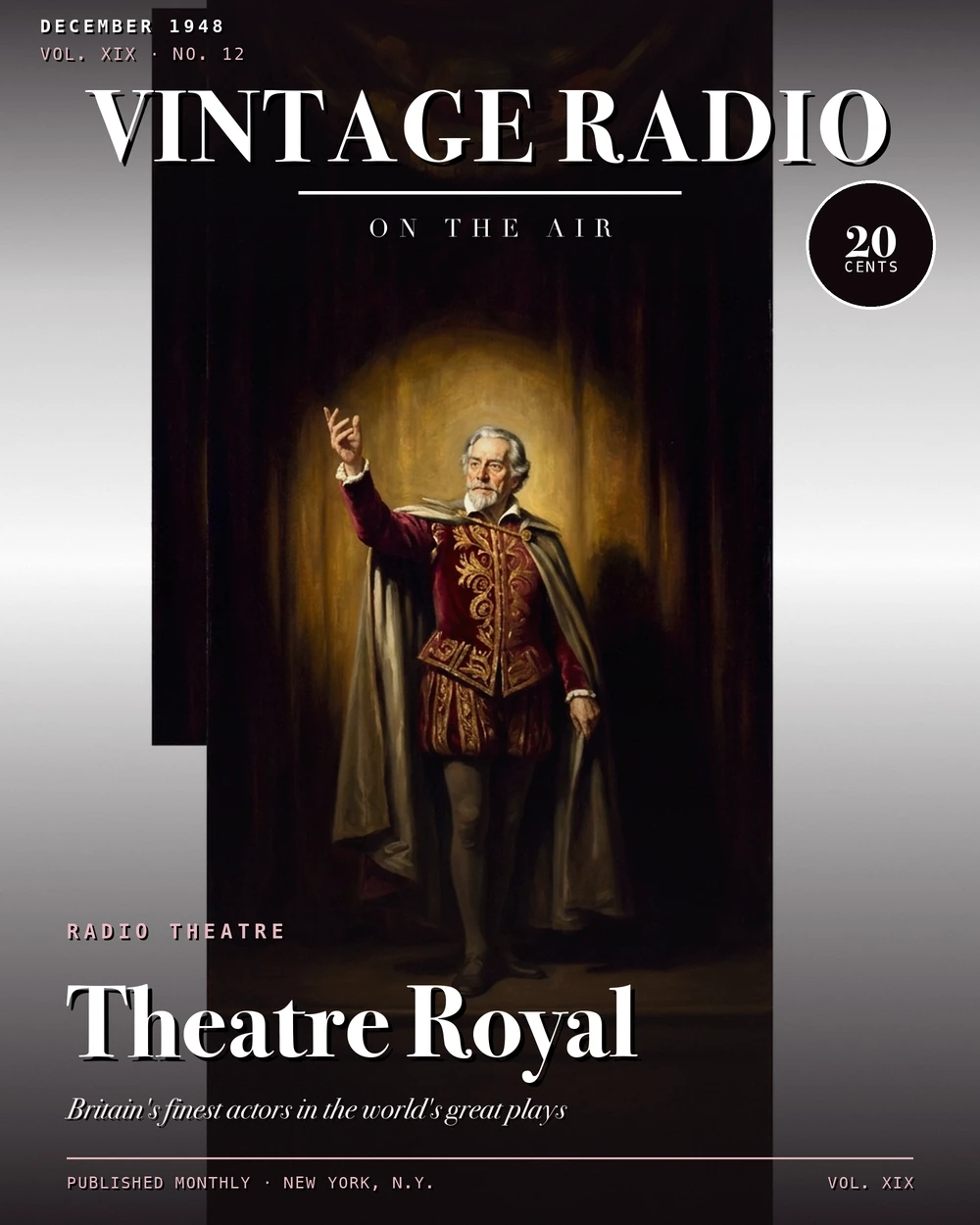
Theatre Royal
The Show That Put Olivier on Radio
Theatre Royal holds a distinction that still surprises people when they hear it: it is the only radio drama series in which Laurence Olivier ever appeared. That alone sets it apart from the crowded field of British radio anthology programming in the early 1950s. Olivier and Ralph Richardson served as hosts, narrators, and leading players across the run, and the series was reportedly developed specifically to capitalize on Olivier's name and talent. Whether or not that origin story flatters the production, the results spoke for themselves.
The series was produced by Harry Alan Towers through his Towers of London production company, which he had founded in 1946 with his mother, Margaret Miller Towers, to syndicate radio programs internationally. Towers had a talent for attaching serious theatrical names to commercially minded radio projects — his other productions included The Black Museum and The Many Lives of Harry Lime — and Theatre Royal was perhaps his most ambitious casting effort. The show was distributed in syndication and reached American audiences, where it remained in circulation well into the 1970s.
The Writers Behind the Scripts
What the series chose to adapt was as distinctive as who performed in it. Theatre Royal drew from a remarkably wide literary range — Robert Louis Stevenson, Charles Dickens, Oscar Wilde, Alexandre Dumas, Honoré de Balzac, Herman Melville, Henry James, Joseph Conrad, Somerset Maugham, H.G. Wells, Jack London, and Fyodor Dostoevsky all appeared in the episode roster. The scope stretched from English and Irish classics through French and Russian literature, giving the series an international reach that was unusual for radio anthology drama of the period.
The documented episode-author pairings reveal how the series matched material to performer. Olivier took on Stevenson's "Markheim" and Wilde's "The Canterville Ghost," as well as Paul Gallico's "The Snow Goose," the Dumas-derived "Zodomirsky's Duel," and Melville's "Bartleby." Richardson handled Somerset Maugham's "The Colonel's Lady." John Gielgud appeared in Max Beerbohm's "The Happy Hypocrite," Robert Donat in Stevenson's "The Sire de Maletroit's Door," and Trevor Howard in Dostoevsky's "The Judgement." These weren't simply radio readings — the series aimed to recreate the texture and tension of live theatre through sound, and music credited to the British organist and arranger Sidney Torch, who also worked on Towers's other productions, gave each episode a consistent sonic frame.
The breadth of the source material wasn't accidental. A producer working with talent at Olivier's level needed scripts that could justify the casting, and prose fiction by major nineteenth- and twentieth-century writers offered a deep well of dramatic material that hadn't been worn thin by stage and screen adaptation. Stevenson's compressed moral fables, Dickens's "A Christmas Carol," Gogol's "The Overcoat," Gallico's wartime fable of the Dunkirk evacuation — each came to the microphone with its own atmosphere already built in.
The Cast Beyond the Headliners
Olivier and Richardson were the marquee names, but the supporting ranks were extraordinary by any measure. John Gielgud, Orson Welles, Alec Guinness, Michael Redgrave, John Mills, Robert Morley, Trevor Howard, and Margaret Lockwood all appeared across the series. Harry Andrews, Muriel Forbes, Robert Donat, and Daphne Maddox filled out the ensemble work. To gather that density of British theatrical talent into a single radio series was unusual, and it gave Theatre Royal a quality of performance that outlasted its original broadcast run.
The Sunday Telegraph called the series "great fun to listen to and, as radio history, they are unsurpassed," and the Radio Times described it as offering "the excitement of vintage radio drama with strong storylines." The series was produced in two series, and the 44 episodes in the catalog represent a run that held together artistically from the first broadcast on October 4, 1953, through the final episode on September 1, 1954.
What Survived and How It Circulated
Theatre Royal had an afterlife more complicated than most radio drama series. Selected episodes were later rebroadcast in the United States under the ABC Mystery Time series title during the late 1950s, with a different series opening and close substituted. The episodes came into wider distribution in the 1970s, when individual installments were often cut to approximately twenty minutes from their original length — which accounts for the variations in running time that turn up in surviving recordings.
Heritage Media later issued the series in collected form, organized by literary nationality: Classic English and Irish Dramas, Classic French Dramas, Classic Russian Dramas, and so on. That structure actually reflects the original programming logic well — the series was genuinely international in its source material, and grouping by literary tradition makes the breadth of the catalog visible in a way that simple chronology doesn't.
Harry Alan Towers went on to produce a related television anthology series, also called Theatre Royal, for ITV/ATV London in 1955, hosted by Lilli Palmer and running for 34 episodes across 1955 and 1956. The radio original remained the more substantial of the two, partly because the cast it had assembled was so deep, and partly because radio suited the theatrical-adaptation format in ways that early television anthology drama sometimes struggled to match.